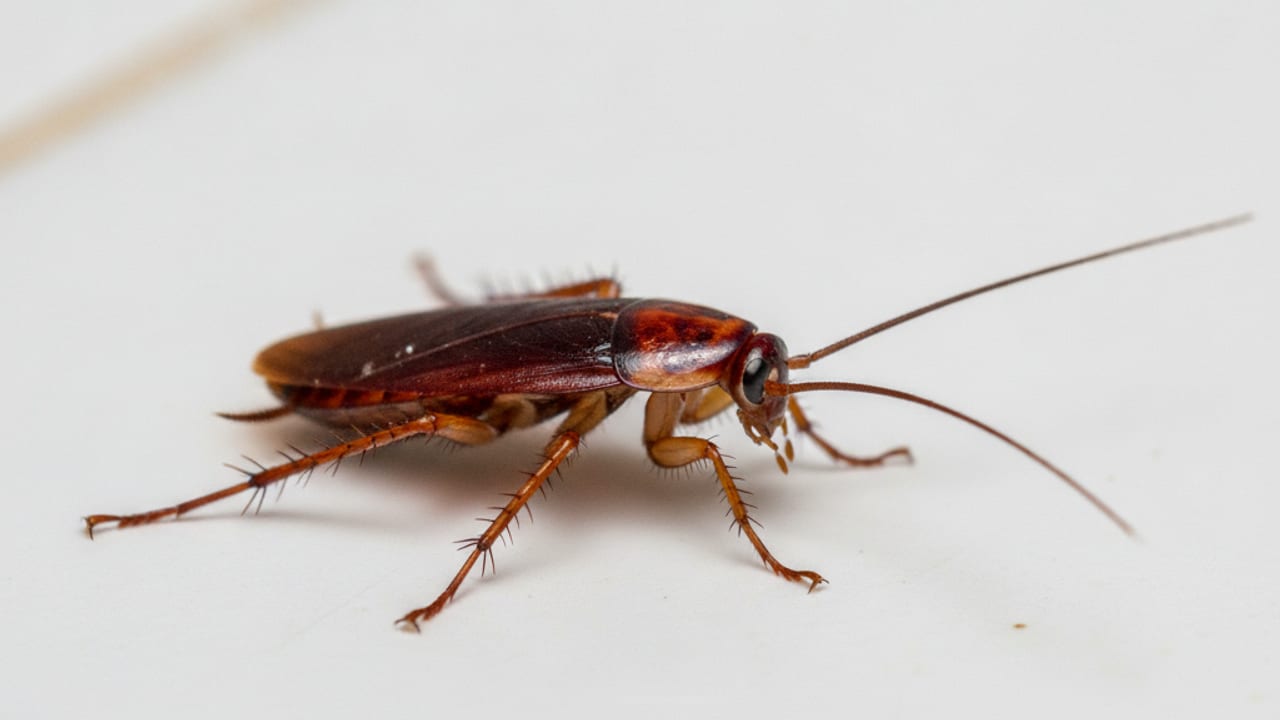
The two cockroaches you will meet in Dubai
Almost every cockroach call in Dubai comes down to one of two species. Telling them apart takes about three seconds once you know what to look for, and it matters more than most people realise. The wrong identification leads to the wrong treatment, and the wrong treatment means the problem never actually goes away.
The quickest way to sort them: look at the size. A small tan cockroach the length of a fingernail is a German cockroach. A large reddish-brown one the length of your thumb is an American cockroach. Everything else, where it lives, how it got in, and how you treat it, follows from that single difference.
The German cockroach: small, striped, indoors
The German cockroach (Blattella germanica) is the small one, about 15mm long, light tan to golden brown, with two dark parallel stripes running down the back of the head. It is the species behind the vast majority of serious infestations in Dubai apartments.
What makes it a problem is where it lives and how fast it breeds. German cockroaches stay indoors permanently. They pack into small warm harbourage: cabinet hinges, the gaps behind and under appliances, the void around plumbing under the sink, inside the motor housing of a kettle or toaster. They are avid feeders and they multiply quickly, so a handful can become a full infestation in weeks.
They also travel between flats. In Dubai towers, German cockroaches move through the shared plumbing risers that connect kitchens and bathrooms floor to floor. This is why a treated flat can become reinfested from an untreated neighbour, and why sealing entry points around pipes matters as much as the chemical work.
This is the hardest household cockroach to eliminate anywhere, and the treatment is gel bait, applied in small dots directly into the harbourage. Bait works because cockroaches carry it back and pass it through the colony, reaching the ones that never come out into the open. Spray alone misses most of them. If you have small striped cockroaches, this is your situation, and our cockroach control service is built around it.
Small striped cockroaches in the kitchen?
That is the German cockroach, and it needs gel baiting, not fogging. WhatsApp us a photo and we will confirm the species and quote the treatment.
WhatsApp now The American cockroach: big and from the drains
The American cockroach (Periplaneta americana) is the big one, roughly 35 to 40mm, reddish-brown, and the cockroach most people picture when they think of the word. It is the one that scuttles across the bathroom floor at night and makes everyone jump.
Here is the key point: it does not breed in your kitchen. American cockroaches live in the drainage system. They range through drains, sewers, bin rooms, and car park gullies, and they enter buildings by coming up through the plumbing rather than by nesting indoors. When you see one, it has usually travelled up from a floor drain, a dry U-bend, or a gap around a pipe.
They are most common in Deira, Bur Dubai, and the older building stock near the Creek, where the drainage network is older and offers more routes in. If you live in these areas, an occasional big cockroach is almost always a drain visitor, not a resident. Our guide to pest control in Deira covers the older-drainage pattern in more detail.
The treatment is completely different from the German cockroach. Because the source is the drains rather than an indoor colony, the work focuses on the entry points: treating and screening drains, sealing gaps around pipes, keeping floor wastes topped up with water so the U-bend stays sealed, plus a residual spray around entry points to knock down anything that comes through. Gel bait in the kitchen does very little here, because the cockroaches are not breeding in the kitchen.
A third type: the Oriental cockroach
There is a third species you will occasionally meet: the Oriental cockroach (Blatta orientalis). It is dark, almost black or very dark brown, and it favours cool damp areas: basements, drains, service voids, and around water sources. It is far less common in Dubai apartments than the other two, but it turns up in ground-floor and below-ground spaces. Like the American cockroach, it is associated with drains and damp rather than kitchen breeding, so the treatment leans the same way: source reduction, drainage, and exclusion.
Side-by-side comparison
| Feature | German cockroach | American cockroach |
| Size | Small, about 15mm | Large, about 35 to 40mm |
| Colour | Light tan with two dark stripes behind the head | Reddish-brown |
| Where found | Kitchens and bathrooms, small warm harbourage (cabinet hinges, behind appliances) | Drains, sewers, bin rooms, car parks, seen near floor wastes |
| Origin | Breeds indoors, lives permanently inside | Enters from the drainage system, does not breed in the kitchen |
| How it spreads | Between flats through shared plumbing risers | Up through drains and pipe gaps from the sewer network |
| Treatment | Indoor gel baiting plus follow-up | Drain and entry-point work plus residual spray |
Why the species changes the treatment
This is the part that saves you money and repeat visits. The two cockroaches need opposite approaches, and using one treatment on the other species barely works.
For the German cockroach, the job is indoor gel baiting: place bait into the harbourage, let it transfer through the colony, then follow up to catch the egg hatch. Spraying the kitchen or fogging the flat mostly misses the colony hiding in the voids. If you have been fogging and still seeing roaches after treatment, mismatched method is often why.
For the American cockroach, the job is drain and exclusion work: treat and screen the drains, seal the gaps, and put a residual barrier around entry points. Gel bait in the kitchen does almost nothing, because the cockroaches are commuting up from the drainage system, not living in your cupboards.
Seeing a big American cockroach does not mean your home is dirty. It means one has travelled up from a drain. The fix is at the drain and the entry point, not the kettle.
So before any treatment, we identify the species. Small and striped means gel baiting the indoor colony. Big and reddish-brown means working the drains and entry points. Get that right and the treatment actually holds. Get it wrong and you are back to square one in a fortnight. If you want to know what either job costs, see our pest control cost guide, and if you want the treatment method explained in full, read the best cockroach treatment guide. Not sure how often to book preventive visits? Our guide to how often you should get pest control breaks it down by property type.
Send us a photo and we will name the species.
Small and striped, or big and reddish-brown? We will tell you which cockroach it is and quote the correct treatment on the spot.
Get a quote FAQ
What is the difference between German and American cockroaches?
Size and behaviour are the two big tells. The German cockroach is small (about 15mm), light tan, and has two dark parallel stripes behind its head. It breeds indoors in kitchens and bathrooms. The American cockroach is large (35 to 40mm) and reddish-brown, and it does not breed in your kitchen at all. It lives in drains, sewers, and bin rooms and comes up into buildings through the drainage system. Because they live in different places, they need completely different treatments.
Which cockroach is in my kitchen?
If you are seeing small tan cockroaches (around 15mm) with two dark stripes behind the head, especially near the kettle, toaster, cabinet hinges, or under the sink, that is the German cockroach breeding indoors. If you occasionally see one big reddish-brown cockroach (35 to 40mm), usually at night near a drain, floor waste, or the bathroom, that is an American cockroach that has come up from the drainage system.
Which cockroach is harder to get rid of?
The German cockroach, by a wide margin. It breeds continuously indoors, hides in tiny warm harbourage you cannot easily reach, and a single female can start a colony of hundreds. It also spreads between Dubai apartments through shared plumbing risers, so a neighbour's infestation can become yours. Gel bait is the correct treatment because it transfers through the colony. American cockroaches are easier because you are dealing with entry from drains rather than an indoor breeding population.
Where do the big cockroaches come from?
The big reddish-brown American cockroaches come up from the drainage system: drains, sewers, floor wastes, bin rooms, and car park gullies. They do not breed inside your flat. They travel through the shared plumbing and enter through dry U-bends, gaps around pipes, and floor drains. This is why they are common in Deira, Bur Dubai, and older buildings near the Creek where the drainage stock is older.
Does seeing cockroaches mean my home is dirty?
No. Seeing a big American cockroach almost always means one has travelled up from the drainage system, not that your home is unclean. Even a spotless flat can get them if a floor drain has dried out or a pipe gap is open. German cockroaches can be brought in through deliveries, second-hand appliances, or shared building plumbing. Hygiene helps limit food and water, but it is not the reason they appear.
Are American cockroaches dangerous?
They are not aggressive and they do not bite in any meaningful way, but they are a hygiene concern. Because they travel through drains and sewers, they can carry bacteria on their bodies and legs and deposit it on surfaces and food. They can also trigger allergies and asthma. They are more of a contamination risk than a direct danger, which is why keeping them out of the kitchen matters.