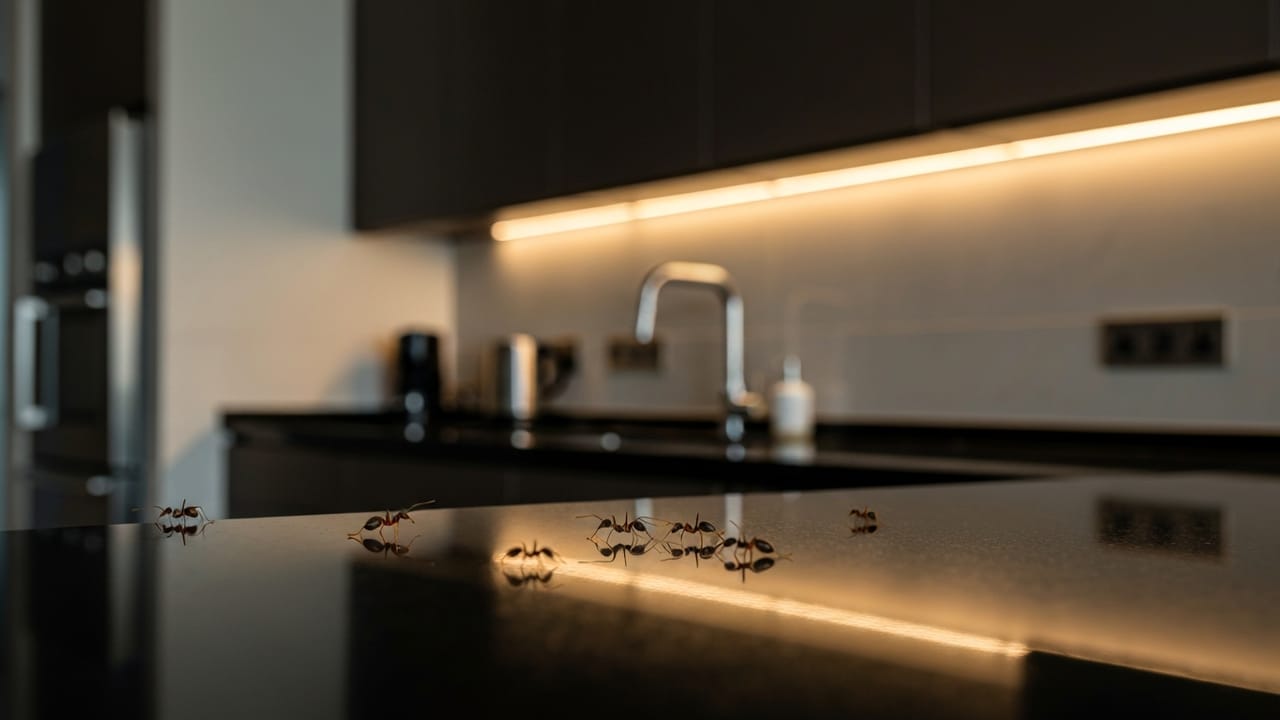
Ant trail you cannot get rid of?
We bait the colony instead of scattering it. WhatsApp us and we will reply with a quote, no inspection fee.
WhatsApp now The ants you actually have
Getting the species right matters, because it changes how you treat them. Indoors in Dubai homes, two ants dominate.
Pharaoh ants are tiny and yellow-brown, and they nest indoors in warm, hidden spots such as wall voids, behind skirting, and around plumbing. They have multiple queens per colony, which is the key to their behaviour: if you disturb them with a repellent spray, the colony buds, splitting into several new nests that scatter through the property. That is what turns one ant problem into three.
Ghost ants are also very small, with a dark head and pale, almost translucent legs and abdomen, which is where the name comes from. Like pharaoh ants, they nest in multiple sites and react badly to repellent sprays.
Outdoors you are more likely to see black garden ants and big-headed ants nesting in soil, under paving, and in garden beds. These often become an indoor problem in summer when they follow food and water inside.
The one rule: do not spray pharaoh or ghost ants
If you take one thing from this guide, take this: do not attack pharaoh or ghost ants with a retail repellent insecticide. Spraying a visible trail feels satisfying because the ants you can see die, but the spray never reaches the queens hidden in the wall voids. Worse, the repellent triggers budding: the surviving workers evacuate the queens and brood and establish several new colonies in new locations. You have now multiplied the problem and made it harder to find. This is the single most common reason ant trails keep coming back in Dubai homes.
Already sprayed and now it is worse?
That is budding. We reset the situation with proper gel baiting that reaches the queens. Message us and we will sort it.
Get a quote Why gel bait works when spray does not
The professional method for these ants is gel bait, and it works precisely because it is slow. A foraging ant finds the bait, eats a little, and carries the rest back to the nest, where it is shared with other workers, the brood, and the queens through normal colony feeding. Because the active ingredient acts slowly, the ant survives long enough to spread it deep into the colony before anything dies. The result is a cascade kill that reaches the queens you can never see, which is the only way to end a multi-queen colony for good.
Gel bait is also non-repellent, so it does not trigger the budding response that sprays do. The ants treat it as food, not a threat. For a closer look at how baiting spreads through a colony, see our guide on how gel bait treatment works.
DIY that actually helps
You cannot bait your way out of every infestation on your own, but there is genuinely useful DIY that supports a treatment and prevents new trails:
- Wipe trails with soapy water. Ants navigate by a pheromone scent trail laid down by scouts. Wiping the trail with soapy water removes that chemical path so the followers lose the route. Do this to the trail, not to the ants clustered on bait.
- Seal food in containers. Sugar, grease, and pet food are the main draws. Airtight containers and clean surfaces remove the reason the scouts came in.
- Fix moisture. Repair dripping taps, dry out the sink area, and do not leave standing water. Ants need water as much as food, especially in summer.
- Use ant gel bait, not spray. A consumer gel bait is the right tool for a light trail. A spray is the wrong tool and will scatter the colony.
What DIY cannot fix is a colony with several hidden nests, which is exactly the pharaoh and ghost ant situation. When there are multiple queens in wall voids you cannot reach, professional baiting placed at the right points is what clears it. Our kitchen pest control guide goes deeper on sealing and exclusion.
Why the ants appeared in the first place
Ants show up for two reasons. The first is the obvious one: food and water. Kitchens offer crumbs, spills, unsealed food, damp sink areas, and pet bowls, so once a scout finds a source it lays a trail and the colony follows. Sugar and grease are the biggest draws, and even a lightly wiped surface can hold enough residue to keep a trail active. The second is heat. In the extreme Dubai summer, outdoor colonies of black garden and big-headed ants move indoors looking for cooler, stabler conditions and reliable moisture, which is why ant calls spike in the hottest months.
If an outdoor colony is feeding your indoor problem, treating only the inside will not hold. The workers you clear indoors are simply replaced by fresh foragers from the garden nest, so the trail reappears within days. This is why villa jobs often need both indoor and garden treatment: the outdoor nest is baited or treated at source while the indoor trails are cleared, so nothing is left to refill the line. Apartments are usually a purely indoor problem, but ground-floor units next to landscaping can behave like villas. See our Dubai pest control page for how we cover villas and apartments.
Indicative cost of ant control in Dubai
As a rough guide, ant treatment costs around:
| Property | Indicative price |
|---|
| Studio | AED 200 to 300 |
| 2 to 3 bedroom apartment | AED 280 to 450 |
| Villa (indoor plus garden) | AED 600 to 1,000 |
These are indicative figures. The final price depends on the size of the property, how many nests are involved, and whether an outdoor colony feeding the indoor trail also needs treating. A quick survey confirms the exact scope. For how ant work compares to other treatments, see our pest control cost guide.
Stop the trail for good.
We bait the colony to the queens instead of scattering it. WhatsApp for a quote, no inspection fee, pay after the job.
WhatsApp now FAQ
Why should I not spray ants?
Because the two most common indoor ants in Dubai, pharaoh ants and ghost ants, respond to repellent sprays by splitting the colony. This behaviour is called budding: when the ants sense a repellent insecticide, the workers carry off queens and brood and start several new nests instead of one. You end up with more colonies in more places than you started with. Retail contact sprays kill the ants you can see and leave the queens untouched, which is why the trail always comes back. The professional method is slow-acting gel bait that the ants carry home to the queens.
What actually gets rid of ants for good?
Gel bait, combined with removing what draws the ants in. Gel bait is slow-acting on purpose: foraging ants eat it, carry it back to the nest, and feed it to the queens and brood before it takes effect, which collapses the whole colony rather than just the visible trail. Alongside baiting, you wipe away trails with soapy water to destroy the scent path, seal food in containers, and fix moisture. For pharaoh and ghost ants with multiple hidden nests, professional baiting is far more reliable than anything off a supermarket shelf.
Why do I suddenly have ants in my kitchen?
Almost always food, water, or heat. Ants forage for sugar, grease, and moisture, and a kitchen offers all three: crumbs, spills, unsealed food, a damp sink area, and pet bowls. In the extreme Dubai summer, an outdoor colony will also move indoors looking for cooler, more stable conditions and a reliable water source. Once a scout finds food it lays down a pheromone trail and the rest of the colony follows, which is why a few ants become a marching line so quickly. Our kitchen guide covers the exclusion side in detail.
How much does ant control cost in Dubai?
As an indicative guide, ant treatment for a studio runs around AED 200 to 300, a two or three bedroom apartment around AED 280 to 450, and a villa that needs both indoor and garden treatment around AED 600 to 1,000. The range reflects the size of the property, how many nests are involved, and whether outdoor colonies feeding the indoor problem also need treating. These are ballpark figures: the accurate price depends on a quick survey of the property and the extent of the activity.
Do ants keep coming back?
They come back when the colony was never fully killed or when the conditions that attracted them are still there. Contact sprays are the classic cause of repeat trails because they kill foragers and scatter pharaoh and ghost ant colonies without reaching the queens. Gel baiting that eliminates the queens, paired with sealing entry points, cleaning up food and water, and treating any outdoor colony feeding the indoor one, is what stops the cycle. If ants return after a professional treatment, it usually means a hidden nest or an outdoor source that still needs work.
Are the ants in UAE homes harmful?
Most house ants in the UAE do not sting or bite in a way that harms people, but they are still a hygiene concern. Pharaoh ants in particular can walk across bins, drains, and food, which makes them a contamination risk in kitchens, and they are a known problem in healthcare settings for exactly that reason. Ghost ants and other indoor ants contaminate food and are a nuisance in numbers. They are not dangerous like some pests, but you do not want them foraging over food preparation surfaces.