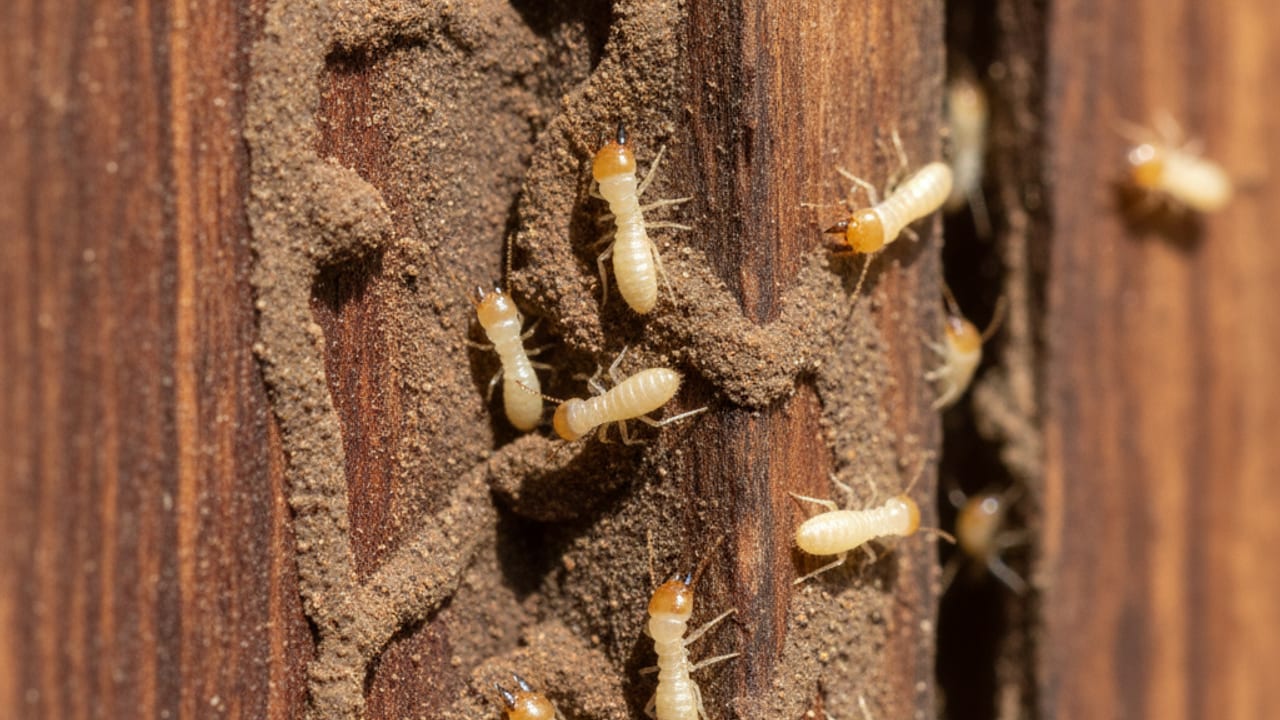
Think you have termites in your villa?
We survey the property, confirm the termite type, and quote the right anti-termite treatment. WhatsApp for a same-day reply.
WhatsApp now The two termite types in the UAE
Two kinds of termite matter in the UAE, and telling them apart decides the whole treatment plan.
Subterranean termites are by far the most common. They live in the soil and cannot survive for long away from moisture, so they build pencil-thin mud tubes to travel from the ground up into a building. Those tubes appear on foundations, walls, and inside cavities. Once inside, subterranean termites attack skirting boards, door frames, and wooden furniture, working from the inside out so the damage often stays hidden until it is advanced. They are the classic villa and ground-floor problem across Dubai.
Drywood termites are much less common. They live entirely inside dry timber and need no contact with soil, so they can infest furniture, roof timbers, and door frames on any floor of a building. Because they stay inside the wood, they leave no mud tubes. The tell-tale sign is small piles of dry, pellet-shaped frass (droppings) that they push out of tiny holes in the timber.
Signs you have termites
Termites are quiet and hidden, so most people notice the symptoms before the insects. Look for:
- Mud tubes on walls, foundations, or inside cupboards: thin, dry earthen tunnels about the width of a pencil. This is the strongest sign of subterranean termites.
- Hollow or crumbling wood: skirting boards, door frames, or furniture that sound hollow when tapped or that crumble under light pressure.
- Discarded wings near windows, doors, and lights, usually after a swarm. Winged termites (alates) shed their wings in small piles once they land.
- Buckling or blistering paint and tiny pinholes in timber or plaster, where termites have tunnelled just beneath the surface.
- Frass piles: small mounds of dry, pellet-like droppings below infested wood, which point to drywood termites.
If you find any of these, resist the urge to break open the tubes or spray the visible insects. Disturbing the colony can scatter it and make the source harder to trace during a survey.
Seeing mud tubes or discarded wings?
Do not disturb them. A quick survey confirms whether it is subterranean or drywood, and we treat accordingly.
Book a survey How termite treatment works
The method depends on the termite type and how the building is constructed. The main approaches used in Dubai are:
Soil (chemical barrier) treatment
This is the standard treatment for subterranean termites. A liquid termiticide, commonly one based on fipronil or imidacloprid, is applied into the soil around the foundation to create a treated zone that termites cannot cross without picking up the active ingredient. In existing buildings this often means drilling small holes through floors and along the foundation perimeter and injecting the termiticide under pressure, then sealing the holes. Fipronil is non-repellent, so foraging termites pass through the treated soil, pick it up, and carry it back through the colony rather than avoiding it.
Termite bait stations
Bait stations are installed in the soil around a property and monitored over time. Foraging termites feed on a slow-acting bait and transfer it back to the colony, which reduces the colony rather than just repelling the termites near the building. Baiting suits situations where drilling and injecting is not practical, or as an ongoing monitoring system after a barrier treatment.
Direct wood treatment
For localised drywood activity or accessible infested timber, the wood itself can be treated directly with a termiticide, either by surface application or by injecting into the galleries. This targets the insects inside the specific piece of timber.
Fumigation for drywood
Where drywood termites are established deep inside timber and cannot be reached directly, whole-structure fumigation with sulphuryl fluoride is used. This is the exception, not the rule, and applies to severe drywood cases rather than the usual subterranean problem. For how fumigation compares to fogging and misting, see our fumigation, misting and fogging guide.
Pre-construction vs post-construction treatment
Anti-termite treatment comes in two timings. Pre-construction treatment is done while a building is going up: the soil beneath and around the foundation is treated before the concrete is poured, creating a barrier from day one. Many Dubai developments include this as standard. Post-construction treatment is what most homeowners deal with: the building already exists, so the barrier has to be created by drilling and injecting around the finished foundation and floors. Post-construction work is more involved because the technician has to reach the soil through the existing structure, which is why access and layout affect the price.
Why Dubai villas get termites
Three local factors make subterranean termites common here. The soil is sandy and easy for termites to tunnel through. The climate is warm year-round, so colonies stay active rather than slowing down in a cold season. And a large amount of timber used in furniture and fit-outs is imported, giving termites a ready food source once they get inside. Put together, that is why villas and ground-floor units, the properties in direct contact with the soil, see the most termite activity in Dubai. If you are comparing risk across areas, see our Dubai pest control page.
Warranty and licensing
A proper anti-termite treatment usually comes with a warranty of 1 to 5 years. The chemical barrier in the soil breaks down gradually, so the warranty reflects how long the treated zone is expected to keep working. Ask what the warranty covers and whether re-treatment is free if activity returns within the term.
Only Dubai Municipality-licensed companies are permitted to apply termiticides. That licensing matters: it means the products, concentrations, and application methods are approved, and it protects you if anything goes wrong. Our guide to Dubai Municipality-approved pest control explains what to check before you hire.
Indicative cost of termite treatment
As a rough guide, a full anti-termite treatment for a villa typically runs from around AED 1,000 to AED 3,000 or more, while apartments and smaller units cost less because there is less foundation area to treat. The final figure depends on the size of the property, the length of the foundation perimeter, whether floors need drilling, the termite type, and the warranty term.
Treat these as indicative only. The accurate price comes from a site survey that confirms the type of termite, the extent of the infestation, and how the building is constructed. For how termite work sits alongside other treatments, see our pest control cost guide.
Protect your villa from termites.
Licensed anti-termite treatment with a written warranty. We survey first, then quote the right method. WhatsApp for a fast reply.
WhatsApp now FAQ
How do I know if I have termites?
The clearest sign of subterranean termites is a pencil-thin mud tube running up a wall, foundation, or skirting board. Other signs include wood that sounds hollow when tapped or crumbles under light pressure, buckling or blistering paint, tiny holes in timber, and small piles of discarded wings near windows and lights after a swarm. Drywood termites leave neat piles of dry, pellet-shaped frass below the timber they are eating. If you see any of these, stop disturbing the area and book a survey: breaking open tubes or spraying visible termites rarely reaches the colony and can make the problem harder to trace.
Are termites common in Dubai?
Yes. Subterranean termites are common across the UAE, and Dubai is a particular hotspot for villas and ground-floor units. Sandy soil, year-round warmth, and a lot of imported timber give subterranean colonies exactly what they need. They live in the soil and travel up into a building through foundations, expansion joints, and pipe penetrations, which is why ground-floor and villa properties are the most affected. Drywood termites also occur but are far less common than subterranean.
What is the difference between subterranean and drywood termites?
Subterranean termites live in the soil and must stay connected to moisture, so they build mud tubes to travel from the ground up into a building. They are by far the most common type in the UAE and cause most villa and ground-floor damage, attacking skirting boards, door frames, and wooden furniture. Drywood termites live entirely inside dry timber and need no soil contact, so they infest furniture, roof timbers, and door frames directly. The giveaway for drywood is small piles of dry pellet frass; the giveaway for subterranean is mud tubes.
How much does termite treatment cost in Dubai?
As an indicative range, a full anti-termite (soil barrier) treatment for a villa typically runs from around AED 1,000 to AED 3,000 or more, depending on the size of the building, the length of the foundation perimeter, whether floors need drilling, and the warranty term. Apartments and smaller units usually cost less because the treated area is smaller. These are ballpark figures only: the accurate price depends on a site survey that confirms the termite type, the extent of the infestation, and the construction of the property.
How long does anti-termite treatment last?
A professional soil barrier treatment usually carries a warranty of 1 to 5 years, depending on the company, the product used, and the property. The chemical barrier in the soil breaks down slowly over time, so the warranty reflects how long the treatment is expected to keep protecting the building. Ask what the warranty covers and whether it includes free re-treatment if activity returns within the term. Bait station systems are monitored and topped up on an ongoing basis rather than lasting for a fixed period.
Is fumigation needed for termites?
Not for the common case. Subterranean termites are treated from the soil with a chemical barrier or with bait stations, not by fumigation. Fumigation with sulphuryl fluoride is used for drywood termites that live entirely inside timber, and even then usually for whole-structure or severe cases where the infested wood cannot be treated directly. Most Dubai termite jobs are subterranean and do not need fumigation. A survey confirms which type you have before any method is chosen.