Snakes keep turning up around the villa?
If one is inside right now, call the municipality first (numbers below). We deal with what keeps bringing them back: rodents, insects and the gaps they use.
WhatsApp now Which snakes live in the UAE?
Peer-reviewed checklists put the UAE's land snakes at 13 or 14 species, plus nine sea snakes recorded in UAE waters. The most recent full survey of the country's land reptiles, published in PLOS ONE in 2019, mapped every land species against habitat and altitude. An earlier checklist by the Environment Agency Abu Dhabi and Zayed University, published in Herpetological Conservation and Biology, added the sea snakes. Older local guides use former names such as Coluber or Ramphotyphlops, so the table follows the names used in the 2019 survey.
| Snake | Venom | Where in the UAE | How to recognise it from a distance |
|---|
| Arabian horned viper (Cerastes gasperettii) | Venomous, medically important | Sand desert at low elevation | Sandy coloured, often buried with only the eyes and snout showing; may or may not have a horn over each eye; leaves sidewinding tracks |
| Sindh saw-scaled viper (Echis carinatus sochureki) | Venomous, medically important | Sand and sandy gravel, mainly in the north | Small and fairly stout; when alarmed it loops into C-shaped coils and rubs its flank scales together to make a sizzling sound |
| Oman saw-scaled viper (Echis omanensis) | Venomous, medically important | Rocky wadis and hillsides in the Hajar Mountains | Same coiled, sizzling defence display, found among rocks rather than sand |
| Persian horned viper (Pseudocerastes persicus) | Venomous, medically important | Rocky mountain slopes in the Hajar | Stout, grey to brown, with a small horn built from several scales above each eye |
| Sea snakes (several Hydrophis species) | Venomous | Arabian Gulf and Gulf of Oman, sometimes stranded on beaches | Flattened, paddle-shaped tail; usually banded |
| Arabian cat snake (Telescopus dhara) | Weak venom, usually not dangerous to people | Hajar Mountains | Slender, large-eyed, active at night |
| Hooded malpolon (Malpolon moilensis) | Mild rear-fanged venom, not medically important | Desert, coast and mountains | Spreads its neck into a hood when cornered; two large dark spots on the sides of the neck |
| Schokari sand racer (Psammophis schokari) | Mild rear-fanged venom, not medically important | Almost everywhere, from sea level to about 1,000m | Long, very slim and fast, often with lengthwise stripes |
| Arabian sand boa (Eryx jayakari) | Non-venomous | Sandy desert | Thick and short, eyes on top of the head, short pointed tail with a claw-like tip |
| Wadi racer (Platyceps rhodorachis) | Non-venomous | Mountains and wadis up to about 1,200m | Long, slim, fast, active by day |
| Clifford's diadem snake (Spalerosophis diadema cliffordii) | Non-venomous | Desert and farmland | Large, pale with a row of darker blotches |
| Brahminy blind snake (Indotyphlops braminus) | Harmless | Urban gardens in Dubai and Abu Dhabi | Under 20cm, shiny dark brown to black, looks like an earthworm |
The checklists also include the hook-nosed thread snake, a burrower that is rarely seen, the small, night-active crowned leaf-nosed snake, and Gray's racer, which in the UAE is known from coastal islands such as Sir Bani Yas and Delma.
Which UAE snakes are venomous, and how dangerous are they?
Only the four vipers in the table are medically important on land, and the 2019 survey is explicit that snakebites in the UAE are rare. Its authors put that down to the vipers being shy, scarce across most of the desert and living mostly where few people do.
Rare is not the same as harmless. Saw-scaled viper venom attacks the blood's ability to clot and causes painful local swelling, which is why any bite from one needs hospital treatment and antivenom, not home care. A horned viper bite is also a hospital case. Sea snakes are a different family whose venom acts on nerves and muscles: the Environment Agency Abu Dhabi describes it as extremely potent, while noting that the snakes are not aggressive and use it when provoked or defending themselves.
Below those sit the mildly venomous snakes: the Arabian cat snake, the hooded malpolon and the Schokari sand racer, whose venom comes from grooved teeth at the back of the mouth and is meant for lizards and small prey. A bite from one should still be shown to a doctor, not least because you cannot always be sure which snake it was.
One point that catches people out: a small snake is not automatically a safe one. Young vipers are venomous from birth, so a short, stocky snake on sand or among rocks deserves the same distance as an adult.
Snakes in the UAE desert, mountains, beaches and gardens
Where you live or walk decides which snakes you could meet, because almost every species keeps to one type of ground.
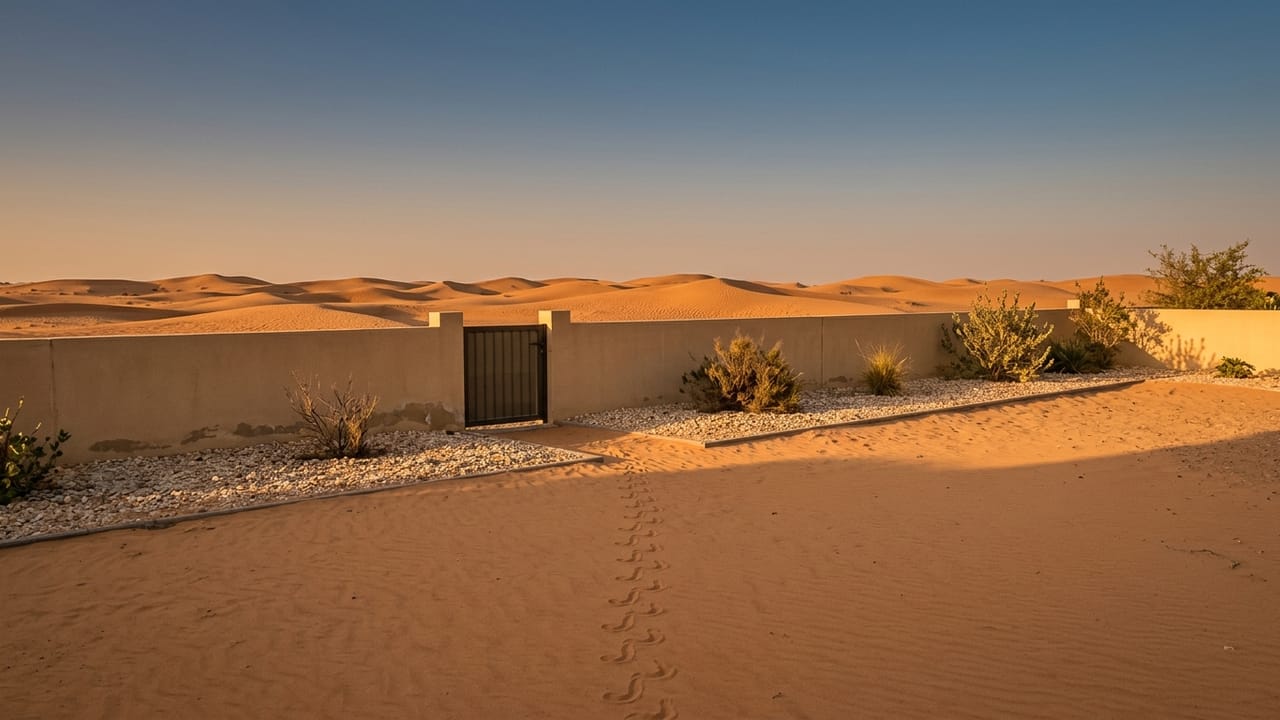
- Desert edge. Villas backing onto sand are in Arabian horned viper and Sindh saw-scaled viper country: the 2019 survey found both mostly below 300m in sand desert, alongside the sand boa and sand racer. Communities such as Arabian Ranches sit on exactly that ground.
- Hatta and the Hajar Mountains. The Oman saw-scaled viper and the Persian horned viper prefer rocky ground and have been recorded from sea level to 1,300m. The Arabian cat snake and the wadi racer share the same rocks. Hikers in Hatta, Ras Al Khaimah and Fujairah are the people most likely to meet any of them.
- Beaches. Sea snakes come into shallow coastal water in the cooler months, and the Environment Agency Abu Dhabi has asked beachgoers not to touch any that wash up.
- Gardens and plant pots. The Brahminy blind snake lives in moist soil and travels in it, which is why it turns up in potted plants and irrigated beds in Dubai and Abu Dhabi. If you are searching for small snakes in the UAE after finding one in a pot, this is almost certainly it.
- Islands. No venomous land snake has been recorded on any UAE island.
How to recognise the dangerous ones without getting close
Assume any snake you cannot name is venomous, keep at least two metres away, and identify it from a photo taken on full zoom. Most of the useful clues work from that distance.
- A sizzling, rasping sound from a coiled snake means a saw-scaled viper. The serrated keels on its flank scales grate against each other as it rubs its coils, and that is a warning to back off.
- Eyes and a snout poking out of sand, or a line of parallel J-shaped marks across a dune, point to a horned viper. Do not wait to see horns: some Arabian horned vipers have none.
- A short, stout body with an abrupt short tail on sand or rock is viper-shaped. Long, slim and fast usually means a racer.
- A flat, oar-like tail on a beach is a sea snake, not an eel.
Two popular rules do not work well here. Pupil shape is unreliable, because the harmless Arabian sand boa has elliptical pupils much like a viper's. A spread hood does not mean cobra either: the hooded malpolon flattens its neck when cornered, and no cobra is native to the UAE.
A snake in your garden or house: what to do right now
Keep everyone back, keep the snake in sight or shut in, and call the municipality for your emirate. Do not try to catch or kill it, since that is the one thing that brings a person within striking range.
- Get children and pets out of the area. Dogs and cats tend to investigate a snake, which puts them within reach of a bite.
- If it is indoors, leave the room, close the door and press a rolled towel along the gap underneath. If it is in the garden, watch it from a distance so you can tell the responders where it went.
- Take a zoomed photo if you can do it without moving closer.
- Call the right number for your emirate:
- Dubai: Dubai Municipality on 800900, the number published for its Public Health Pest Control Section. Gulf News has reported that snake calls on this line are routed to a team that can collect the animal.
- Abu Dhabi, Al Ain and Al Dhafra: 800555 or the TAMM platform. Since May 2024 pest control in the emirate has been run by the Abu Dhabi Public Health Centre rather than Tadweer, and the government announcement of the change lists snakes among the pests it covers.
- Sharjah: the municipality call centre on 993, which runs around the clock. The municipality says it has a dedicated team for snake sightings.
- Ajman, Umm Al Quwain, Ras Al Khaimah and Fujairah: call your municipality.
- Anyone in immediate danger, anywhere: 999.
PestsGone does not catch, remove or relocate snakes. A snake in the house is a job for the municipality team, and that is where we will point you if you message us about one.
Is snake removal free?
Neither Dubai Municipality nor the Abu Dhabi Public Health Centre publishes a fee for dealing with a snake at a home, and neither publishes a promise that it is free, so ask when you call. Dubai Municipality's page for its public health pest control service lists citizens' homes among the places it treats and gives 800900 as the contact. Abu Dhabi's service is requested through 800555 or TAMM and covers residences. Private wildlife removal firms charge their own rates, so if you go that way, get the price before anyone comes out.
As for snake removal products sold online, most fall into the repellent category covered below. The other common one, the glue trap, catches lizards, birds and pets as readily as snakes, and a snake stuck to a board still has to be handled by someone trained to do it.
If someone is bitten: first aid that matches WHO advice
Call 998 for an ambulance, keep the person still and get them to hospital, because antivenom is the most effective treatment and it is only given there. The World Health Organization's first aid advice for snakebite comes down to a short list.
- Move away from the snake. If it is still attached, use a stick or tool to make it let go.
- Remove rings, watches, bracelets, anklets and tight clothing near the bite before swelling starts.
- Reassure the person. Many bites are from non-venomous snakes, and panic makes everything harder.
- Keep the whole body still and splint the bitten limb. Carry the person rather than let them walk.
- Paracetamol can be given for pain. If they vomit, lay them on their left side and watch their breathing.
The same guidance is just as clear on what to avoid: never apply a tight tourniquet, and do not cut the wound, suck it, use a black stone or try herbal remedies. WHO reserves the firm pressure-bandage method for snakes with nerve-acting venom that cause no local swelling, which does not describe the UAE's land vipers, so after a bite on land, splint and go. Do not try to catch the snake to take with you; a photo is enough.
Sea snake bites need the same urgency. A bite can look minor to begin with, so go to hospital even if the person feels fine.
Why snakes come close to homes
Snakes come to houses for food, shelter and the cooler, damper ground around them, and food is the one you can do the most about. Most UAE snakes eat rodents, lizards or both, so a garden with mice under the decking and geckos at every light is advertising a meal.
The chain usually runs like this. Outdoor lights pull in insects, insects feed geckos and other lizards, and lizards and rodents feed snakes. Our guide to house geckos explains how quickly gecko numbers follow insect numbers. Rodents are the bigger draw: bird seed, pet food left outside, open bins and compost all support mice and rats, and our guide to getting rid of rats in Dubai covers how they get into villas.
Shelter matters almost as much. Piles of leftover tiles, blocks and pallets, stacked pots, palm frond heaps, dense ground cover against the wall and gaps under sheds all give a snake shade and cover close to its food. Irrigation adds water and damp soil, which draws in the insects and small animals that snakes and their prey live on. The same features shelter scorpions, so the work described in our guide to scorpions and spiders in the UAE overlaps heavily with this.
Construction is the other trigger. When a neighbouring plot is cleared, its rodents and the snakes that hunt them move to the nearest cover, often the first row of finished villas.
Mice in the garden, geckos at every light?
That is the food chain snakes follow. We treat the rodents and insects and show you which gaps to close.
Get a quote Do sulphur, mothballs and snake repellents work?
The evidence that they work is weak. In a study published through the University of Nebraska's Great Plains wildlife damage proceedings, behaviour trials with 96 snakes and field tests at 24 sites found no meaningful avoidance of naphthalene, sulphur or a commercial blend of both. The author concluded that the snakes could probably sense the chemicals but that their drive to find cover outweighed any deterrent effect, and recommended against relying on these products. The test animals were North American garter snakes rather than Arabian species, but we could find no independent trial showing that these products keep vipers or any other UAE snake away.
Mothballs carry an extra problem. They release naphthalene vapour, are designed for closed containers, and can harm children and pets when scattered around a garden. The pesticide regulator at Clemson University in the United States has asked homeowners to stop using them outdoors against snakes for exactly that reason.
Electronic snake repellers have an even weaker case. Snakes pick up mostly low-frequency sound and ground vibration, far below the ultrasound these units emit, and our article on whether ultrasonic pest repellers work explains why reptiles in general cannot hear them. Money spent on any of these is better spent on the steps below.
What actually keeps snakes away from a villa
Remove the food, remove the cover and close the gaps. None of it involves a snake product.
- Control rodents properly. Bait stations, traps and proofing together, not a poison block in a corner. A professional rodent control service finds the entry points as well as treating the animals.
- Cut the insect load. Fewer insects means fewer geckos. Yellow-spectrum outdoor bulbs, lights mounted away from doors, and an exterior insect treatment where numbers are high all help.
- Clear the cover. Move building leftovers, pallets and frond piles off the plot, store pots and materials on racks rather than on the ground, and keep a clear strip between planting and the house wall.
- Close the gaps. Brush seals on external and garage doors, mesh over weep holes and vents, sealed pipe and AC penetrations, intact drain covers and no gap under the side gate.
- Manage water and food left out. Fix leaking irrigation, bring pet bowls in at night, and keep bins closed and away from the wall.
On the desert edge, expect the occasional sighting whatever you do. The aim is a garden with nothing worth staying for.
Killing, catching and keeping snakes: the legal side
The short version: do not keep a wild snake, and there is no need to kill one. Under Federal Law No. 22 of 2016 on the possession of dangerous animals, the Ministry of Climate Change and Environment has said that owning, possessing, trading in or breeding the animals listed in the law's annexes is limited to licensed bodies such as zoos, breeding centres and research institutions, and legal summaries of the annex list snakes and vipers among them. The Arabian sand boa is also listed under CITES Appendix II, which regulates international trade in the species.
Some UAE snakes are of conservation concern in their own right. The 2019 survey lists Gray's racer as Vulnerable on the UAE's national Red List and notes that it does not occur inside any protected area. The harmless species, which are the large majority, also eat a share of the rodents you would otherwise be paying to control. Leave them for the municipality team, or simply let them move on.
Make the villa less interesting to snakes.
Rodent control, insect treatment and an exclusion checklist for homes on the desert edge. For a snake in the house now, call your municipality first.
WhatsApp now Sources
- An integrative assessment of the diversity, phylogeny, distribution, and conservation of the terrestrial reptiles (Sauropsida, Squamata) of the United Arab Emirates, PLOS ONE
- Sea Snake, Environment Agency Abu Dhabi
- Snakebite envenoming: Treatment, World Health Organization
- Abu Dhabi Public Health Centre expands services to include public health pest control, Abu Dhabi Media Office
- The Efficacy of Naphthalene and Sulfur Repellents to Cause Avoidance Behavior in the Plains Garter Snake, University of Nebraska-Lincoln, Great Plains Wildlife Damage Control Workshop Proceedings
FAQ
Which snakes in the UAE are venomous?
Four land snakes are classed as medically important: the Arabian horned viper, the Sindh saw-scaled viper, the Oman saw-scaled viper and the Persian horned viper, all members of the viper family. The sea snakes in UAE waters are venomous too. A few other land snakes, such as the Arabian cat snake and the hooded malpolon, have weak venom delivered from grooved teeth at the back of the mouth, but they are not regarded as dangerous to people. If you cannot identify the snake that bit someone, treat the bite as venomous and go to hospital.
Are there sea snakes on UAE beaches?
Yes. Sea snakes live in both the Arabian Gulf and the Gulf of Oman, and the Environment Agency Abu Dhabi has recorded four species in Abu Dhabi waters alone. They move into warm shallow water in the cooler months and currents sometimes strand them on the sand, with sightings reported near Saadiyat Island and the Abu Dhabi Corniche. They are venomous but not aggressive. Leave a stranded one alone even if it looks dead, tell the beach management or call 800555 in Abu Dhabi, and take anyone who is bitten to hospital straight away.
What is the tiny black snake in my plant pot?
Almost certainly a Brahminy blind snake, often called the flowerpot snake. It stays under 20cm, is shiny dark brown to black, and is so thin that most people take it for an earthworm until it moves. It is harmless to people and feeds on ants and termites. The species is not native: it reached the UAE in imported soil and has been recorded in urban gardens in Dubai and Abu Dhabi. Every individual is female and reproduces without a mate, so a single snake arriving in a pot can start a population. Lift it out with a trowel and put it in a flower bed.
Who removes a snake from a house in Dubai?
Call Dubai Municipality on 800900, the number published for its Public Health Pest Control Section. Gulf News has reported that snake calls on that line are routed to a team that can collect the animal. While you wait, get people and pets out of the room, shut the door and press a rolled towel against the gap underneath so the snake stays where you know it is. In Abu Dhabi the equivalent route is 800555 or the TAMM platform, and in Sharjah it is the municipality call centre on 993.
Is snake removal free in the UAE?
There is no published charge for a snake call-out at a home from Dubai Municipality or the Abu Dhabi Public Health Centre, but neither publishes a statement that it is free, so ask when you call. In Abu Dhabi, the 2024 announcement that moved pest control from Tadweer to the Abu Dhabi Public Health Centre named snakes among the pests the service covers. Private wildlife removal firms set their own prices. PestsGone does not catch, remove or relocate snakes.
What is the first aid for a snake bite in the UAE?
Call 998 for an ambulance, move the person away from the snake and keep them still. Take off rings, watches, anklets and anything tight near the bite before swelling starts, and splint the limb so it cannot bend. Do not apply a tight tourniquet, cut the wound or try to suck out venom. The World Health Organization says paracetamol can be given for pain and that a person who vomits should be laid on their left side. Antivenom is only given in hospital, so the priority is getting there quickly.