Tiny pale bugs you cannot identify?
Send us a close-up photo and where you found them. We will tell you what they are and whether the fix is drying, cleaning or treatment.
WhatsApp now What booklice actually are
Booklice are tiny, soft-bodied insects called psocids that feed on microscopic mould, not on books and not on people. The University of Florida IFAS Extension sheet on booklice and silverfish points out that the word "lice" is misleading, because none of them are parasites. Their outdoor relatives, barklice, live on tree bark and leaves.
Their diet is mould and fungi, plus cereal dust, starch and fragments of dead insects. Utah State University Extension notes that what draws them to books is the mould on damp paper rather than the glue, although UF/IFAS adds that they graze the starch sizing along page edges. That diet is what makes them useful: a booklouse is a moisture reading with legs. Find a cluster and you have found a surface damp enough to grow mould, often before the mould itself is visible.
They breed fast once conditions suit them. Many species reproduce without males, so every adult can lay eggs. Utah State gives a generation time as short as 25 days in ideal conditions, and UF/IFAS puts development from egg to adult at 30 to 60 days, with each female laying 50 to 60 eggs in the warm months.
How to identify booklice
A booklouse is 1 to 2 mm long, pale and soft, has no wings, and runs in quick, jerky bursts. Most people see a moving speck rather than an insect, so a phone camera on macro or a hand lens makes a big difference.
- Size. UF/IFAS gives indoor species as usually under 1.5 mm. The MuseumPests.net fact sheet, written for museum and archive collections, says usually 1 to 2 mm. Young ones are smaller and paler still.
- Colour. Translucent white, cream, grey or light brown. On a white shelf they look like moving grains of salt.
- Shape. A large head, a plump abdomen, long thread-like antennae and bulging eyes, as Utah State describes them, with noticeably thickened thighs on the hind legs according to MuseumPests.
- Wings and movement. Indoor species are wingless, and they neither fly nor jump. Insects of a similar size with wings, gathered near a window or a light, are more likely barklice that have wandered in from outside.
The quickest test comes from the museum world: hold a suspect book, packet or piece of cardboard over a sheet of dark paper and tap it a few times. Pale specks that drop out and start running are booklice.
Booklice or something else?
Several small pests get mistaken for booklice, and size, leg count and location usually separate them within a minute. These are the ones most often confused in UAE homes.
| Bug | Size and look | Where you see it | Bites people? |
|---|
| Booklice | 1 to 2 mm, pale white, grey or beige, soft, wingless, six legs, big head, long antennae. Quick, jerky runs. | Damp shelves, food packets, books, cardboard, grout, mattress seams | No |
| Bed bugs | Adults 4 to 5 mm, flat, oval, reddish brown. Young ones smaller and paler. | Mattress seams, bed frame joints, headboard, with dark spotting | Yes |
| Grain and flour mites | Smaller than booklice, eight legs, pale. In numbers they look like a fine dust that moves. | Flour, cereal, powdered milk, damp packets and the shelf around them | No |
| Bird mites | About the size of a full stop, eight legs, pale until they feed. | Near windows, AC units and walls next to a pigeon nest | Yes, once the birds leave |
| Young German cockroaches | A few millimetres, dark brown to almost black with a pale stripe. Freshly moulted ones are briefly white. | Near appliances, the sink and food, mostly at night | No |
| Silverfish | 10 to 12 mm, silvery scales, carrot shaped, three bristles at the tail. | Bathrooms, store rooms, paper and cardboard | No |
| Weevils and flour beetles | 2 to 3 mm, hard shell, reddish brown to dark. Rice weevils have a long snout. | Inside rice, flour, grains and spices | No |
| Carpet beetle larvae | 4 to 5 mm, bristly, banded brown hairs, slow moving. | Under furniture, along rug edges, in wardrobes | No, but the hairs can irritate skin |
If the table points to bed bugs, our guide to bed bug signs and bites covers the mattress check properly. Hard-shelled beetles inside rice or flour are dealt with in the weevils section of our kitchen pest control guide, and silvery, carrot-shaped insects in the bathroom belong in the silverfish guide. A cockroach that looks almost white is usually a nymph that has just shed its skin; what baby cockroaches look like shows the difference.
The lookalike that shares the same damp cupboard is the grain mite. University of Kentucky entomologists describe the first sign as "mite dust", a fine pale layer on a shelf, bag or counter that turns out to be moving. A female can lay up to 800 eggs and the cycle from egg to adult takes about two weeks, but the fix is almost the same as for booklice.
Booklice do not feed on people. If you are waking up with bites and seeing tiny specks near a window or the AC unit, think about bird mites, which move indoors looking for a new host once pigeons abandon a nest on a ledge or AC platform. Our pigeon control guide covers nest removal.
Why UAE homes get booklice
UAE homes get booklice wherever cooled surfaces, humid air and still air meet, because that combination keeps a surface damp enough to grow mould even in a desert climate. The air outside can be dry for months while the inside of a cupboard is a very different place.
- AC condensation. Chilled water pipes, fan coil units and their drain pans sweat when humid air reaches them. Gaps in the pipe insulation or a backed-up drain line keep the surrounding cupboard or ceiling void permanently damp.
- Flats closed up over summer. With the AC off for weeks, the air inside takes on outdoor humidity and nothing moves it, so cupboard interiors, mattresses and wardrobe backs get time to grow a mould film.
- New buildings. Concrete, plaster and gypsum board hold water long after construction, and new kitchen units and wardrobes are fitted into that. Utah State lists construction materials among the damp items booklice live in. Provided nothing is leaking, it settles as the structure dries.
- Humid coastal months and humidifiers. Late-summer air on the coast carries a lot of moisture, and open balcony doors, laundry dried indoors and a bedroom humidifier set high all add to it, right where AC-cooled surfaces are waiting.
- Stored dry food and paper. Flour, semolina, oats, spices and pet food in opened packets absorb moisture, and Utah State notes that booklice in stored grain mean the grain is too warm and moist. Cardboard boxes and document files on a store room floor sit in the coolest, stillest air in the home.
In practice that means under the kitchen sink, the cupboard beside the dishwasher or kettle, corner units on an external wall, bathroom grout and silicone, window frames, mattress seams and bed bases, bookshelves, and patches of damp plaster on walls and ceilings.
Booklice keep coming back after you clean?
That usually means the damp source is still there. Send us photos and where you keep finding them, and we will tell you what to check first.
Get a quote The humidity numbers that matter
Keep the affected space below 50% relative humidity and booklice cannot survive there; at 65% or above they multiply. UF/IFAS Extension gives the same target of below 50%, and the MuseumPests.net fact sheet sets out both ends of the range.
| Relative humidity in the affected spot | What it means for booklice |
|---|
| Below 50% | Most species do not survive. Hold it there and the population dies out. |
| 50 to 65% | Marginal. Some may hang on, so this is not low enough to clear an infestation reliably. |
| 65% and above | Populations increase. |
In the laboratory work MuseumPests summarises, one species died within 6 days at 43% relative humidity and the slowest of those tested within 16 days at 50%. Temperature gives no help in a UAE home: booklice become active from about 10°C and feed more as it warms towards 32°C, which covers every air-conditioned room all year.
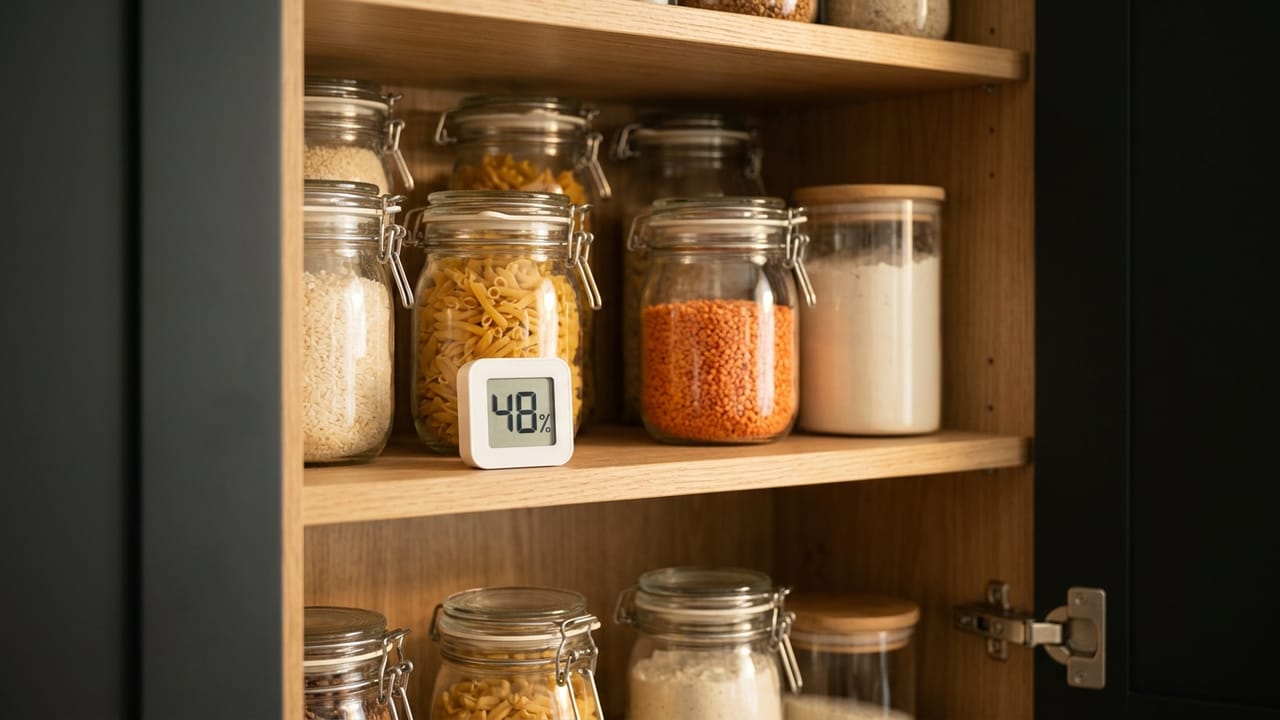
Measure rather than guess. Put a digital hygrometer inside the affected cupboard, close the door overnight and read it in the morning. The room can feel perfectly comfortable while a cupboard built around a sweating pipe reads much higher, and the cupboard is what counts. Aim for 45 to 50% there and hold it for two to three weeks, so that eggs laid before you started also hatch into dry conditions.
Do booklice bite, and are they harmful to health or food?
No, booklice do not bite and do not transmit disease. Utah State University Extension says so directly, and MuseumPests describes them as no threat to people or pets. They have chewing mouthparts for grazing mould and no interest in blood, so booklice in bed are an unpleasant find rather than a medical one. If you have bites, something else is responsible.
Food is a contamination question. UF/IFAS notes that heavy populations can contaminate food to the point it must be thrown away, and a packet with booklice in it has, by definition, taken on enough moisture to grow mould. Throw those packets out. Sealed jars and tins from the same shelf are fine once wiped.
Books and papers suffer less than people fear. MuseumPests calls booklice slow eaters whose damage stays minor unless a population goes unchecked for a long time. The damp is the bigger long-term threat to the paper.
How to get rid of booklice, step by step
Find the damp, get the space below 50% relative humidity and keep it there, clear out what they are living in, and clean off the mould film; the insects then die off on their own over a few weeks. In order:
- Map them, then find the water. Note every spot you see them and tap packets and books over dark paper. Then check the sink trap and flexible hoses, the dishwasher and washing machine connections, the AC condensate line and drain pan, the insulation on chilled water pipes, the wall behind the unit, the ceiling above, and any window frame that runs wet.
- Fix it, or report it. A dripping trap or a blocked AC drain is a maintenance job, not a pest job, and nothing below works while it continues.
- Dry the space. Empty the cupboard and leave the doors open. Run a dehumidifier in the closed room set to 45 to 50%, or the dry mode on a split AC unit if it has one. Moisture-absorbing tubs help in small enclosed cupboards. Confirm the result on the hygrometer.
- Clear the food. Bin every packet with live booklice in it and check every other dry item in the same cupboard. Clean items go back in airtight glass, metal or plastic containers, which is the University of Kentucky's standing advice for opened dry goods.
- Use the freezer for the right job. The University of Kentucky's low-temperature table shows that one day at about -18°C kills every stage of the common pantry beetles, weevils and moths, while a fridge at around 0 to 2°C takes weeks to months. MuseumPests notes that freezing below -18°C kills most booklice species but not Liposcelis bostrychophila, a common indoor species. So freezing protects clean food from other pantry pests; it does not make an infested packet worth keeping.
- Vacuum and clean. Run the crevice tool along shelf joints, hinge recesses and the gap behind the shelves, then empty the vacuum outside. Wipe with hot soapy water and let everything dry completely before restocking. Chipboard or MDF that is swollen or stained dark behind a panel may need replacing.
- Sort books, papers and cardboard. Tap items out over dark paper, air them in a dry room, and store them in sealed plastic boxes kept off the floor, as MuseumPests recommends. Valuable books can be frozen in a sealed bag and thawed inside it so condensation lands on the plastic, but drying matters more than freezing here.
- Deal with the bed. Wash bedding and the mattress protector hot and dry them fully, which UF/IFAS advises for bedding and furnishings. Strip any plastic off a new mattress, vacuum the seams and base, stand it on its edge in a ventilated room for a day, raise it off the floor, and turn the humidifier down.
- Monitor. Leave the hygrometer in place and set a sticky insect monitor in the cupboard. Catches should fall week by week. If they do not, moisture is still getting in somewhere.
Why spraying rarely helps
Spraying kills the booklice you can see and leaves the damp and mould that produce the next generation, so they come straight back. UF/IFAS says chemical control is not usually necessary once moisture has been reduced. Utah State says insecticides are rarely used for booklice and urges caution in food preparation areas. MuseumPests puts it most simply: existing populations will prosper unless the conditions that caused them change.
- Food shelves are the wrong place for insecticide. For grain mites, which live in the same cupboards, the University of Kentucky says there are no good chemical solutions and advises against insecticides in food storage areas.
- A water-based spray adds moisture to the very surface you are trying to dry.
- Diatomaceous earth is a poor bet. It is recommended online for almost every crawling insect, but MuseumPests reports it has not been found effective against psocids.
For what household sprays can and cannot do, see our guide to pest control sprays in the UAE, and we look at whether ultrasonic repellers work separately. Targeted treatment does have a place: a heavy population in wall voids or kitchen plinths you cannot reach, after the damp is fixed, can justify a crack and crevice application by a licensed technician using a product labelled for indoor use. Never on food shelves, and never instead of drying.
When a professional is worth calling
Call for help when the damp is beyond what you can find or fix: the hygrometer will not come down to 50% with a dehumidifier running, the booklice are back after two or three weeks of drying, or they turn up in several rooms at once. The usual reasons are:
- Hidden leaks. A slow leak inside a wall, a failing seal on a shower tray, or water arriving from the flat above.
- Building-wide damp. Neighbours seeing the same thing, chilled water risers sweating in shared service cupboards, or a damp common store room. These belong to building management.
- Mould behind panels. Dark staining behind kitchen units, on wardrobe backs, above false ceilings or under vinyl flooring, which needs a maintenance or mould remediation contractor to open up.
- Doubt about the insect. Bites, droppings or anything else that does not fit booklice deserves an identification before money goes on the wrong fix.
A useful visit includes identification, moisture readings with a written note of where the damp is coming from, removal of infested material, and treatment only where drying alone will not finish the job. If the real fix is a plumber or an AC technician, a straight company tells you that first.
If the damp comes from the building
If the cause is a building defect, such as a leaking pipe inside a wall, a blocked AC drain line the landlord maintains, or water coming through from the flat above, the repair normally sits with the landlord, and the booklice go once it is done. Our guide to who pays for pest control in Dubai explains how tenancy law and your contract split responsibility, and how to escalate.
Take dated photos of the insects, any staining or drip, and the hygrometer reading inside the affected cupboard, and send them in writing with a request to inspect the leak or drain. Be fair about the other side too: if the source is a humidifier on full every night or laundry dried indoors, that part is yours to change.
Booklice treatment across the UAE.
Identification, moisture readings at the affected spots, and treatment only where drying alone will not finish the job. Send your property details and a photo for a price.
WhatsApp now FAQ
Do booklice bite or spread disease?
No. Booklice have chewing mouthparts for grazing mould and do not feed on blood, so they cannot bite you the way bed bugs or mites do. Utah State University Extension states plainly that they do not bite or transmit disease, and the MuseumPests.net fact sheet describes them as no threat to people or pets. If you are getting bites in bed, look for another cause: dark spotting on the mattress seams points to bed bugs, and bites that started after pigeons nested by a window point to bird mites.
Why are there booklice on my new mattress?
Because the mattress, or the spot it sits in, has been damp enough for a thin film of mould to grow. A mattress that spent weeks sealed in plastic can hold moisture against the fabric, and a bed pushed against a cool wall or placed next to a humidifier stays more humid than the rest of the room. Take off any plastic, vacuum the seams and the base, wash the bedding hot and dry it fully, and get the bedroom below 50% relative humidity on a hygrometer. They are not bed bugs and they are not feeding on you.
Do I need to throw away food that had booklice in it?
Yes, throw away any packet with live booklice in it. Their presence means the food has taken on moisture, and UF/IFAS Extension notes that heavy infestations can contaminate food to the point it has to be discarded. Check every other dry item in the same cupboard, move anything clean into airtight glass, metal or plastic containers, and wipe sealed jars and tins before they go back. Do not count on freezing to rescue an infested packet, because at least one common indoor booklouse species survives freezing at -18°C.
Will a dehumidifier get rid of booklice on its own?
Often, yes, provided it gets the affected space below 50% relative humidity and keeps it there. Most booklice species cannot survive below that level, and in the laboratory work summarised by MuseumPests.net the slowest species to die took 16 days at 50%. A dehumidifier running in a closed room set to 45 to 50% for two to three weeks, with the cupboard doors left open, clears many infestations. It will not work if a leak keeps wetting the cupboard again, so fix the water first.
Why do I have booklice in a brand new apartment?
New buildings are wet inside. Concrete, blockwork, plaster and gypsum board hold water for a long time after construction, and new kitchen units and wardrobes are fitted straight into that environment. Add AC pipework and ducts that sweat, plus a flat that may have stood closed for weeks before handover, and mould films form where you cannot see them. Booklice follow the mould. Keep the AC and bathroom extraction running, use a dehumidifier in the worst rooms, and report any leak to the developer or your landlord in writing.
How long does it take to get rid of booklice?
Once the damp source is fixed and the space stays below 50% relative humidity, expect numbers to fall away over two to three weeks. In laboratory work the hardiest species tested died within 16 days at 50%. A real home is less tidy than a laboratory: humidity swings with the weather and the AC, and mould residue lingers in corners, so a few stragglers over the following weeks are normal. If you still see them after a month at a confirmed 50%, the moisture is coming from somewhere you have not found yet.