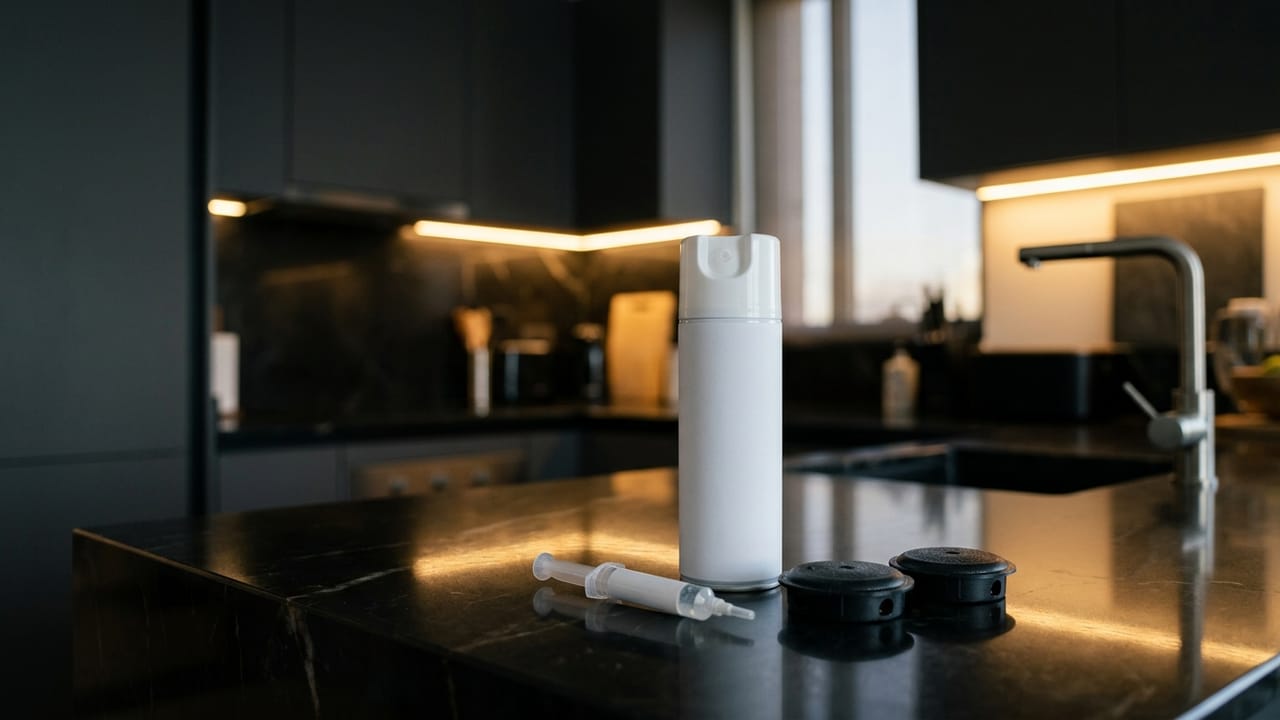
Bought three products and still seeing pests?
Send us a photo of the pest and of the products you have used. We will tell you honestly whether a shop product can still work or whether the problem needs a treatment.
WhatsApp now The main product types at a glance
Almost everything sold for home pest control in the UAE falls into seven groups, and the group tells you more than the brand name or the insect pictured on the pack.
| Product type | What it does | Fits |
|---|
| Flying insect aerosol | Fast knockdown in the air, little residue | A wasp indoors, a few flies or mosquitoes |
| Crawling insect aerosol | Kills on contact, short-lived residue | A single cockroach you can see |
| Residual surface spray | A film that kills insects crossing it for a period | Thresholds, balcony door tracks, villa perimeters |
| Gel bait and bait stations | Eaten and carried back to the nest | German cockroaches, small indoor ants |
| Dusts such as boric acid | Swallowed during grooming | Dry voids and cracks |
| Vaporisers, mats and coils | Release a volatile insecticide into a closed room | Mosquitoes in a bedroom at night |
| Traps | Physical capture, or monitoring | Mice, flies, finding cockroach hot spots |
Ultrasonic plug-ins sit on the same shelf but contain no insecticide at all. Whether they do anything is covered in our look at whether ultrasonic pest repellers work.
What is inside a pest control spray
A household pest control spray is a small dose of insecticide in a solvent or water base, and the active ingredients are almost always pyrethroids, sometimes with natural pyrethrins. The National Pesticide Information Center (NPIC) describes pyrethrins as chemicals found naturally in some chrysanthemum flowers, and pyrethroids as the longer-lasting, human-made chemicals modelled on them. Both overexcite the insect nervous system, which leads quickly to paralysis.
Flying insect aerosols release a fine mist meant to hang in the air. Many also list piperonyl butoxide (PBO), which is not an insecticide in its own right: NPIC explains that it blocks some of the enzymes insects use to break the insecticide down, giving the active ingredient more time to work.
Crawling insect aerosols, sold as cockroach and ant killers, usually pair two pyrethroids with different jobs. A very fast one such as imiprothrin flushes insects out and knocks them down, while a more stable one such as cypermethrin stays behind as a residue. Published labels for this kind of product list each active at well under one per cent, commonly between 0.07 and 0.2 per cent.
Residual surface sprays are meant to keep killing for days or weeks, but exposure time is the catch. A University of Kentucky study of common consumer residual insecticides found they killed German cockroaches well when sprayed directly onto them, yet far fewer died after 30 minutes on a treated surface, and under continuous exposure the products took at least 24 hours, some up to five days, to kill them all. A cockroach crossing a treated skirting board does not linger that long.
Many sprays are also repellent, driving cockroaches and ants deeper into the building, which is why our DIY pest control guide keeps sprays and bait in separate zones. Pyrethroid resistance is well documented in German cockroaches too, so a can that worked a few years ago may barely slow the next generation.
Active ingredients decoded
The active ingredient decides what a product can do, not the brand. These are the names printed on packs sold in the UAE and in professional service reports.
| Active ingredient | Usually found in | What it does |
|---|
| Pyrethrins | Flying insect aerosols, sprays sold as natural | Fast nerve poison that breaks down within hours in sunlight; highly toxic to fish |
| Cypermethrin, permethrin, deltamethrin, bifenthrin | Crawling insect aerosols, residual sprays | Same nerve target, far more stable; cats are especially sensitive to permethrin |
| Imiprothrin, tetramethrin, prallethrin, transfluthrin | Aerosols, mosquito vaporisers and mats | Very fast knockdown with little lasting residue; vaporiser versions fill a closed room while switched on |
| Piperonyl butoxide | Listed with pyrethrins and pyrethroids | Blocks the enzymes insects use to detoxify; kills nothing on its own |
| Fipronil, indoxacarb, imidacloprid, hydramethylnon, abamectin | Gel baits, ant baits, bait stations | Slow poisons taken in by feeding, so the insect gets back to the nest first |
| Boric acid | Dusts, liquid ant baits, some gels | Stomach poison swallowed while grooming; slow, and useless once wet |
| Pyriproxyfen, methoprene | Some flea products, professional treatments | Insect growth regulators that stop insects maturing; nothing dies quickly |
Two rules follow. If the label lists only fast knockdown pyrethroids, it is a contact product, not a long-term fix. If it lists a slow active ingredient in a food base, it is bait, and spraying near it cancels it out. The University of California Statewide IPM Program names abamectin, boric acid, fipronil, hydramethylnon, indoxacarb and imidacloprid as the active ingredients in cockroach baits, and our page on how gel bait works explains why they are deliberately slow.
Gel baits, bait stations and the pest control box
Bait is the only shop product that reaches pests you cannot see, because the insect does the delivery. A consumer gel syringe uses the same families of active ingredient as professional gel, usually at lower strength, and the bigger gap is the number of placement points, which our comparison of cockroach treatments sets out.
Sealed bait stations hold the bait inside a plastic housing with small entry slots. They are tidier and safer around children and pets than open gel, but a pack covers only a handful of spots, so put them where insects already shelter: under the sink, behind the fridge and beside the dishwasher.
Searches for a pest control box in the UAE return three different products: a lockable rodent bait station (a heavy plastic box with a key, rodent-sized entry holes and a rod that holds bait blocks in place), the insect stations above, or a bundled kit of spray, gel and traps. The rodent box needs care, because its bait is designed to kill a mammal. The University of California Statewide IPM Program advises tamper-resistant stations wherever children, pets or other animals could reach bait, and warns that a pet can be poisoned by eating a single rodent killed by anticoagulant bait. In an apartment, snap traps are usually the safer choice for a mouse, since a poisoned rodent can die inside a wall void you cannot open.
Traps: snap, glue, sticky monitors and light traps
Traps carry no chemical risk, and two of them are among the most useful items in the pest aisle.
- Snap traps are the most reliable tool for a mouse indoors. Use a pea-sized bait, set several flush against the wall where droppings appear, and for rats follow the UC IPM advice to leave traps baited but unset until the bait has been taken a few times, spaced roughly 3 to 6 metres apart, because rats are wary of new objects.
- Glue boards are sold for rodents, but UC IPM describes them as difficult to use against rats and not generally recommended for non-professionals. They should never go outdoors, where birds, lizards and other wildlife get stuck, and indoors they belong inside a box pets cannot reach.
- Sticky monitor traps for insects are the cheapest diagnostic tool you can buy. UC IPM calls sticky traps the best way to detect and monitor cockroaches: lay them at wall and floor junctions near the sink, fridge and bin, check daily, and the busiest trap shows where bait should go.
- Insect light traps can work against flies indoors where they are not competing with daylight. Choose the glue-board kind for a kitchen, because UC IPM warns never to use an electric zapper near food preparation: insect body parts can be thrown several feet from the grid.
Not sure which product fits your pest?
Send a clear photo on WhatsApp. If a shop product can handle it, we will say so and tell you which type to look for.
Ask us Which product fits which pest
Match the product to how the pest lives, not to the picture on the can. This is the short version for the pests UAE homes see most.
| Pest | Product type that fits | Leave on the shelf |
|---|
| German cockroaches (small, in kitchens) | Gel bait in hinges and voids, sticky monitors | Aerosols and foggers, which scatter them |
| American cockroaches (large, from drains) | A crawling insect spray for the one you see, residual spray at floor drains and thresholds | Foggers |
| Small indoor ants | Ant bait gel or liquid bait on the trail | Any spray on the trail |
| Bed bugs | Mattress encasements and monitors while you arrange a treatment | Bed bug killer sprays and foggers |
| Mosquitoes | A vaporiser in the bedroom, repellent on skin, emptying standing water | Fogging the flat |
| House flies | Glue-board light trap, fly ribbon, sealed bins | Zappers near food |
| Mice | Snap traps along the walls | Loose poison pellets |
| Booklice | Lower humidity, discard mouldy paper and dry goods | Insecticide sprays |
Booklice show the limit of sprays well: they feed on microscopic mould in damp corners, so drying the room out does the work, as our booklice guide explains.
How to read a pest control label
The label is the only reliable description of what you bought, so read it in the shop. The National Pesticide Information Center's guide to reading pesticide labels breaks a label into the parts below, and a product sold in the UAE should let you find each one.
- Active ingredient and percentage. This places the product in one of the groups above. Two brands with the same active ingredient do the same job.
- Target pests and use sites. Check your pest is listed and the product is for indoor use. Gulf News reported in 2018 that the Ministry's labelling states whether a product is for domestic or garden use.
- Registration details. Ministerial Decision No. 27 of 2018 makes registration with the Ministry of Climate Change and Environment a condition of import and sale, and it covers the stickers on pesticide packaging. No registration details, no purchase.
- Signal word or hazard symbols. Products made for the US market use signal words, where CAUTION is the lowest tier, WARNING is higher and DANGER the highest. Others use hazard pictograms. A stronger warning means more care, not a better product.
- Directions, re-entry and first aid. How much to apply, how long to keep the room closed, when people and pets can return, and what to do after exposure. Read the first aid before you need it.
- Storage. Aerosol cans carry a warning against temperatures above 50°C, and a car parked in the summer sun can exceed that, so do not leave cans in the boot.
What is restricted to professionals in the UAE
Household products are one corner of the pesticide market, and much of what licensed companies buy is not meant for homes. Federal Law No. 10 of 2020 on Pesticides makes the Ministry of Climate Change and Environment responsible for registering pesticides and keeping a central database, and gives local authorities the licensing and inspection of the businesses and stores that handle them, plus approval of pesticide advertising. Ministerial Decision No. 27 of 2018 sets out the procedure: every pesticide, including ready-to-use products, attractants and repellents, must be registered before it is imported or circulated, a registration runs for five years, and banned pesticides cannot be registered at all.
Dubai Municipality also publishes a list of approved professional use, business to business biocides: the concentrates licensed companies dilute on site with calibrated sprayers, protective equipment and trained technicians. At a 2018 awareness workshop on household pesticides, the municipality urged residents to use accredited companies rather than buy concentrated products meant for them. Our guide to Dubai Municipality approved pest control covers the chemical families licensed companies use.
The most dangerous products in the country are not on any supermarket shelf. Abu Dhabi Police have warned that aluminium and magnesium phosphide tablets are not authorised for household insect control. They release phosphine gas that smells of garlic or carbide, there is no suitable antidote, and early symptoms are easily mistaken for food poisoning. The warning records deaths in Dubai and Fujairah, with tablets bought from agricultural and veterinary supply shops or carried back from home countries.
If anyone offers you a tablet, powder or "bomb" that clears the whole flat in one go, refuse it. In Dubai you can report it to Dubai Municipality on 800900.
Where to buy pest control products
A search for a pest control shop near me usually leads to one of four kinds of outlet. Supermarkets, hypermarkets and cooperative societies carry aerosols, gel syringes, bait stations and vaporisers. Hardware and home improvement stores add snap traps, rodent stations, door sweeps and sealant, which often do more than any can. Garden centres stock products labelled for outdoor use, such as granular baits. Online marketplaces and delivery apps carry all of these plus third-party imports, so check that the product photos show registration details and a readable label, because a can shipped in from abroad may never have been registered here. Specialist pest control suppliers mainly serve licensed companies. Wherever you shop, leave unlabelled powders, refilled bottles and anything sold loose by weight where you found them.
Using pest products safely at home
Safe use comes down to the label, the room and who else lives in the home.
- Children. Keep products in their original containers, high up or locked away; the US Environmental Protection Agency's citizen's guide warns never to transfer pesticides into other containers such as drink bottles. Check every bait placement from a crawling child's eye level.
- Pets. Cats clear pyrethroids poorly, fish are very sensitive to pyrethrins and pyrethroids, and birds react badly to anything airborne. The species-by-species detail is in our guide to pest control and pets.
- Ventilation. Dubai Municipality's 2018 advice was to leave the area being sprayed, close windows and air conditioning while spraying, keep the room closed for 20 minutes, then open the windows. Never spray near an open flame or a lit hob.
- Never mix. Do not combine two insecticides, add cleaning products to a spray, or spray over gel bait. A homemade mixture has no label, no tested safety margin and no first aid instructions.
- Foggers. The US Environmental Protection Agency's precautions are one per room at most, at least six feet (about 1.8 metres) from gas hobs, pilot lights and appliances that cycle on and off such as fridges and air conditioners, never inside cupboards or under counters, and everyone including pets out for the time on the label, usually two to four hours.
- Empty cans. Do not puncture, burn or reuse them. Bag them and put them out with household waste.
- If someone feels unwell. Move them to fresh air, follow the label's first aid and take the container, or a photo of the label, to the doctor. In an emergency, call 998 for an ambulance.
Where a product cannot fix the problem
A shop product treats the pests it touches in the place you put it, so it fails whenever the problem lives somewhere you cannot reach. Bed bug eggs survive consumer sprays and the adults scatter, which is a job for a bed bug treatment with a follow-up visit. Cockroaches living in a shared riser restock your kitchen however well you bait it. Termites are structural and never a job for a can. Rats coming in from outside keep arriving until the entry point is found and sealed. And anything still active after four weeks of the right product used correctly has a source the products are missing, which an inspection finds faster than another round of shopping.
When the shop products stop working.
Tell us your area, the pest and what you have already tried. We quote a treatment that reaches the places a can never will.
WhatsApp now FAQ
Which pest control spray is safe to use around pets?
No insecticide spray is safe for every animal, so the useful question is which product carries the least risk for the pet you have. Cats clear pyrethroids poorly, and pyrethroids are the active ingredients in most household aerosols, so a cat should be shut out of the room until treated surfaces are dry. Fish are very sensitive to pyrethrins and pyrethroids, which means covering the tank and switching off the air pump before anything is sprayed. In a home with pets, bait gel placed inside hinges and voids, sealed bait stations and snap traps inside a covered box all involve far less exposure than spraying floors and skirting. A pet friendly claim on the front of a pack does not replace the directions for use on the back.
Do bed bug killer sprays from shops work?
They kill the bugs they hit and very little else. Bed bug eggs are protected from most consumer sprays, the bugs shelter in seams, joints and wall gaps a spray never reaches, and many products are repellent, which pushes bed bugs out of the bed and into sofas, skirting and the next bedroom. The US Environmental Protection Agency also advises that total release foggers should not be the only method used against bed bugs. A shop spray can lower the number you see for a few days. Clearing an infestation needs an inspection, treatment of every hiding place and a follow-up timed to the egg hatch.
What is a pest control box?
In UAE shop listings the phrase usually means one of three things. Most often it is a lockable rodent bait station: a sturdy plastic box with a key, entry holes sized for rats or mice, and a rod inside that holds bait blocks so they cannot be shaken out. It can also mean a pack of sealed cockroach or ant bait stations, the small plastic discs placed under sinks and behind appliances. Some sellers also use it for bundled starter kits combining a spray, a gel and a few traps. Check which one you are buying, because a rodent station holds a poison designed to kill a mammal and has to sit where children and pets cannot reach it.
Can residents buy the chemicals that pest control companies use?
Not through ordinary shops, and you should not go looking elsewhere. Dubai Municipality publishes a separate list of approved professional use, business to business biocides: the concentrates licensed companies dilute on site with calibrated equipment, protective gear and trained technicians. The municipality has publicly urged residents to use accredited companies rather than buy concentrated products meant for them. Some products are controlled far more tightly still. Aluminium and magnesium phosphide tablets, sometimes sold as a bomb, release phosphine gas, are not authorised for household insect control and have killed residents in the UAE. If a shop or a cheap operator offers one, refuse it.
How can I tell if a pest control product is registered in the UAE?
Check the pack before you buy. Ministerial Decision No. 27 of 2018 requires every pesticide, including ready-to-use sprays, attractants and repellents, to be registered with the Ministry of Climate Change and Environment before it can be imported or circulated, and it also covers the stickers carried on pesticide packaging. The registration details should sit on the label or a sticker alongside the active ingredient, its percentage, the target pests and the directions for use. A product with no registration details, no named active ingredient, or a label you cannot read in Arabic or English should stay on the shelf. When a company treats your home, ask for the product label and safety data sheet.
Are bug bombs safe to use in a Dubai apartment?
A registered fogger used exactly as its label says is not illegal, but it is a poor fit for most flats. The US Environmental Protection Agency advises one fogger per room at most, placement at least six feet (about 1.8 metres) from ignition sources such as gas hobs, pilot lights and appliances that cycle on and off like fridges and air conditioners, never using one inside cupboards or under counters, and leaving the home for the time on the label, usually two to four hours. In a compact apartment kitchen those distances are hard to achieve. The fog also settles on open surfaces and does not reach the voids where cockroaches and bed bugs live, so you get residue without control.